What Is STEM? The Essential Guide to Modern STEM Studies in 2025
STEM studies have transformed education by bringing science, technology, engineering, and mathematics together under one roof. My experience shows that students learn better through hands-on experience and critical thinking than traditional subject-by-subject teaching.
STEM studies emerged as an educational model from the National Science Foundation in the 1990s to spark interest in scientific and technical careers. The concept grew in 2006 when Georgette Yakman added art to create STEAM, which brought creativity into technical education.
The job market clearly shows STEM’s importance. About 75% of jobs in growing industries need workers with STEM skills. More than 30 promising careers will need STEM knowledge soon. Many countries, including the United States and European nations, now make STEM a key part of their education systems.
STEM education builds strong problem-solving skills and readies students for innovative workplaces. It goes beyond technical knowledge to develop the critical 7Cs Skills needed today: Critical Thinking, Creativity, Collaboration, Communication, Informatics and ICT Education, Intercultural Career, and Learning Understanding.
What is STEM and how did it start?
«STEM education is all about connecting classroom activities and experiences to real-life opportunities.»
— Teachwire, Educational resource platform for teachers
STEM wasn’t always the educational buzzword we know today. The original approach to integrating science, technology, engineering, and mathematics started as «SMET» in the early 1990s. People first documented its use back in 1993 [1]. The National Science Foundation (NSF) used this acronym to describe their focus on improving science, mathematics, engineering, and technology education.
The meaning behind STEM and STEAM
A most important move happened in 2001 when Judith Ramaley, NSF’s assistant director of education and human resources, rearranged the acronym to create «STEM» [2]. This simple change would affect how we talk about integrated science education for years to come.
The concept grew further in 2006 when researcher Georgette Yakman added an «A» for arts, creating STEAM [3]. This addition expanded the approach to include fine art, drama, graphic design, visual arts, music, and language arts. STEM focuses on practical skills development, while STEAM combines technical knowledge with creative expression.
The role of Seymour Papert and early programming
Mathematician Seymour Papert’s significant work preceded STEM’s mainstream adoption in the late 1960s. This South African-born computer scientist developed the Logo programming language specifically for children [4]. His revolutionary tool let young learners control a virtual «turtle» that drew shapes and patterns on screen. It made abstract computational concepts easy to understand.
Papert’s educational philosophy, «constructionism,» centered on students learning best by creating things rather than just receiving knowledge [5]. His groundbreaking work at MIT shaped modern technology education and became the foundation for today’s hands-on STEM methods.
How STEM became a global education model
STEM education gained urgency in the early 2000s after international studies like TIMSS and PISA revealed American students lagging in science and mathematics. The United States ranked 21st out of 30 countries in scientific competency [2].
The bipartisan congressional STEM Education Caucus formed to address this challenge. They emphasized that state-of-the-art ideas drive our knowledge-based economy, and these ideas come from a STEM-skilled workforce [2].
STEM-focused curriculum has now spread worldwide. Australia, China, France, South Korea, Taiwan, and the United Kingdom have developed their own programs [2]. This global adoption shows how integrated, hands-on STEM learning prepares students for our technical and interconnected future.
Why STEM matters in today’s world
Technology drives our society, and STEM studies connect educational reform with economic needs. Students need science, technology, engineering, and mathematics to prepare for a world that’s evolving faster. Technical literacy has become as basic as reading and writing.
STEM and the future of work
Technical expertise has become valuable in every industry, and the job market reflects this change. STEM occupations will grow twice as fast as non-STEM fields through 2029, according to labor statistics. STEM graduates earn 26% more than their non-STEM peers, whatever career path they choose.
Technical literacy matters beyond scientific careers. Modern industries like banking, healthcare, manufacturing, and creative fields need employees who understand data analysis and technological tools. They want people who can solve problems systematically. STEM education brings value even to students who don’t pursue purely scientific careers.
How STEM supports innovation and problem-solving
STEM studies create a mindset that spots challenges and develops solutions. Students work on ground problems through project-based learning. They use scientific methods and engineering principles that build resilience and adaptability. These skills matter especially when you have a world that changes so quickly.
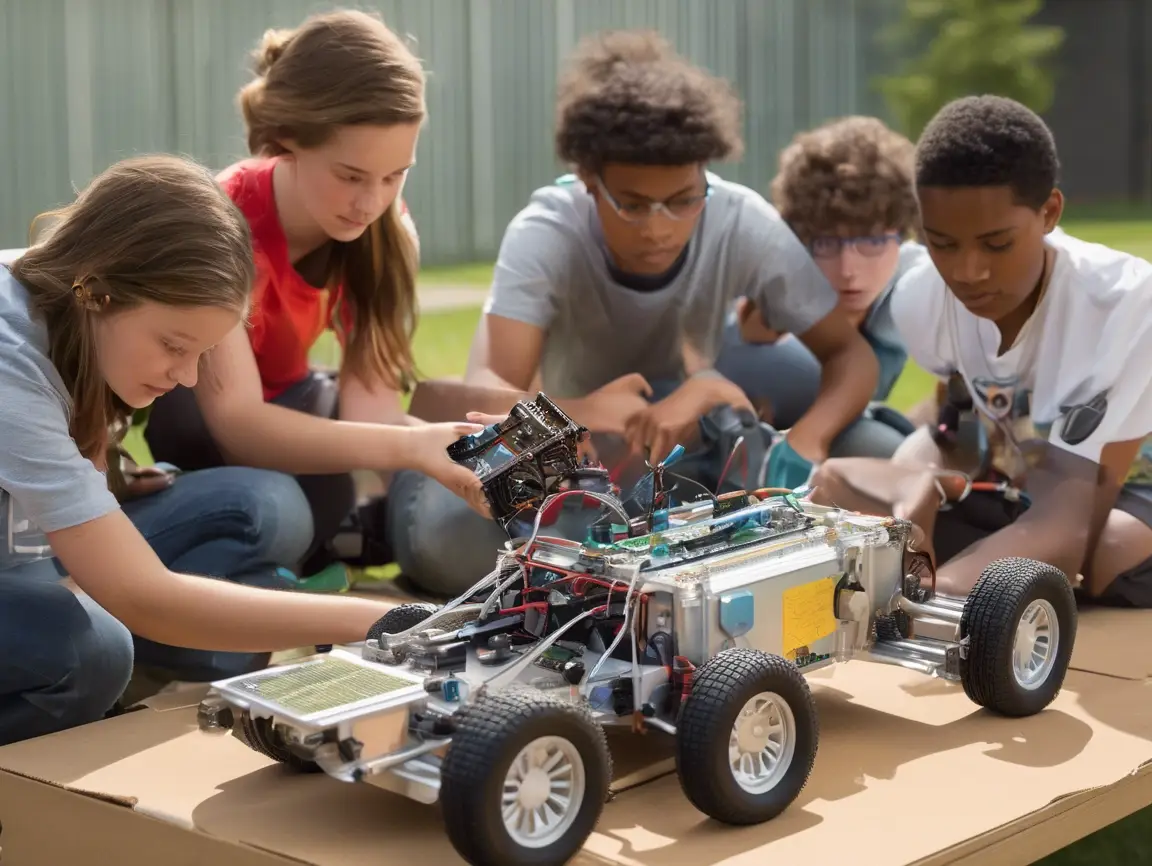
STEM brings subjects together instead of keeping them separate like traditional education does. To cite an instance, see a student designing a solar-powered vehicle. They must work with scientific principles, engineering limits, and mathematical calculations all at once. This matches how real-life innovation works.
Reducing fear of science and math through hands-on learning
Math and science have scared many students traditionally. STEM methodology fixes this by using real experiences instead of abstract concepts. Students build bridges, program games, or analyze environmental data rather than memorizing formulas.
Hands-on learning makes tough subjects more available as challenges. Students who find textbook learning difficult often find hidden talents when they experiment and create. Solving practical problems builds confidence beyond the classroom. These students ended up becoming lifelong learners who feel comfortable with technical subjects rather than fearing them.
Core principles of STEM methodology

Image Source: Academik America
Several foundational principles set STEM education apart from traditional subject-separated learning models. These core methods shape students’ development of technical expertise and essential life skills.
Teamwork and collaboration
Modern STEM studies thrive on collaboration. Research shows that teams generate knowledge more frequently and their work affects disciplines more deeply [6]. Employers rank teamwork as the second most important career readiness attribute, right after critical thinking and problem-solving [6]. Students gain better content knowledge and conceptual understanding through teamwork [6]. Yet grouping students together isn’t enough—they need explicit training in collaboration skills like conflict resolution, communication, and planning.
Real-world problem solving
Students learn STEM best by tackling authentic challenges instead of abstract concepts. They see their learning’s immediate relevance by working on real-life problems from industry and community settings [7]. This method improves motivation while showcasing career opportunities [7]. A school demonstrated this through its partnership with a biotechnology company where students visited laboratories and developed solutions to avoid contamination [8]. This showed how STEM skills apply to actual industry challenges.
Learning through experimentation
Direct investigation serves as the life-blood of effective STEM methodology. Students build understanding through hands-on experience rather than memorization [7]. Hands-on, minds-on activities [9] help students become comfortable with experimentation and failure—vital attributes to create state-of-the-art solutions. Research indicates that experiential learning improves students’ comprehension and enthusiasm by a lot [10].
Multidisciplinary teaching
STEM subjects work best when taught alongside other academic areas and real-life experiences [9]. This all-encompassing approach combines material from multiple STEM disciplines into shared learning experiences [7]. One researcher noted, «at the nano level atoms do not belong to any field of science» [11]. This shows how artificial subject boundaries become when solving complex problems.
Creativity and critical thinking
STEM methodology nurtures creative problem-solving and critical thinking at its core. Students need chances to practice decision-making while solving problems to tackle complex challenges [12]. Critical thinking in STEM leads to better decisions through reasoning, skills, and experienced scientists’ and engineers’ knowledge [12]. Creativity grows when students work on open-ended projects with multiple solutions [12]. This strengthens a mindset that questions preconceived notions.
Benefits of STEM education across life stages
STEM education’s benefits build up uniquely at every stage of life. These advantages start in early childhood and continue through career growth. Research shows how stem studies help shape brain development, academic success, and future job prospects.
Early childhood development
Young children’s natural curiosity lines up perfectly with what are stem studies all about—exploring and finding new things. Kids who learn STEM concepts through play tend to:
- Build essential skills in spotting patterns, thinking logically, and analyzing [13]
- Grow more confident and positive about learning [14]
- Get better at focusing and switching between tasks [15]
Research shows that learning STEM early relates directly to better grades later, just like early reading does [16]. Kids at this age are ready to learn and happy to make sense of everything around them [17].
Improved academic performance
STEM education keeps delivering clear benefits beyond the early years. A detailed study revealed that students in STEM programs outperformed about 70% of their classmates who didn’t take part in STEM activities [16]. On top of that, structured STEM activities showed strong positive effects on how students solve problems and reason mathematically [15].
STEM experiences help students find new interest in subjects that might seem tough or abstract [16]. This renewed involvement leads to sharper critical thinking, deeper understanding of concepts, and better overall grades.
Career readiness and employability
STEM education gives students real advantages as they enter the workforce. Latest predictions suggest that 80% of future jobs will need math and science skills [18]. STEM graduates typically earn more money in any industry, even in jobs not traditionally seen as STEM-focused.
Beyond technical skills, STEM education develops abilities that transfer to any job. Employers value teamwork, communication, problem-solving, and critical thinking—exactly what STEM teaches [1]. These skills prepare graduates for today’s complex, tech-driven workplace where adapting quickly matters most.
Conclusion
STEM education has changed learning for students of all ages. Without doubt, STEM means much more than just an acronym—it shows a fundamental change in how we prepare students for an increasingly technical world.
STEM studies give students everything they need to know that goes nowhere near just scientific knowledge. Students develop the critical 7Cs Skills that employers desperately want: Critical Thinking, Creativity, Collaboration, Communication, Informatics, Intercultural Career, and Learning Understanding. These skills become powerful assets whatever career path they choose.
Research shows clear and measurable benefits of STEM. Children who learn STEM concepts early build stronger cognitive foundations. Older students perform better academically, with STEM students scoring higher than 70% of their non-STEM peers. Adult learners also find better jobs and earn more money.
STEM’s core methods—collaboration, ground problem solving, experimentation, and multidisciplinary teaching—line up perfectly with how state-of-the-art ideas come to life. Students learn not just what to think but how to think. They build confidence and lose their fear of mathematics and science.
STEM literacy will become as basic as reading and writing by 2025 and beyond. Tools may change, but knowing why systematic problem-solving, critical analysis, and creative innovation happens will stay crucial. These abilities will define success in virtually every industry and profession soon.
STEM education stands as our best way to prepare students for rapid technological change. Instead of teaching isolated facts that students forget quickly, STEM creates adaptable minds ready for tomorrow’s challenges—challenges we can’t imagine yet but must all the same prepare for.
FAQs
Q1. What is STEM education and why is it significant?
STEM education integrates science, technology, engineering, and mathematics into a cohesive learning paradigm. It’s crucial because it develops critical thinking, problem-solving, and innovation skills essential for success in today’s technology-driven world and prepares students for future careers across various industries.
Q2. How does STEM education differ from traditional learning approaches?
STEM education emphasizes hands-on, experiential learning and real-world problem-solving. Unlike traditional subject-separated models, STEM promotes interdisciplinary thinking, collaboration, and creativity, allowing students to apply knowledge across multiple fields simultaneously.
Q3. What are the long-term benefits of STEM education for students?
STEM education provides numerous long-term benefits, including improved academic performance, enhanced critical thinking skills, better career readiness, and higher employability. STEM graduates often earn higher salaries and are better equipped to adapt to rapidly changing job markets.
Q4. How does STEM education contribute to early childhood development?
In early childhood, STEM education fosters natural curiosity and exploration. It helps develop foundational skills in pattern recognition, logic, and analysis. Early exposure to STEM concepts can enhance executive function skills, build self-confidence, and correlate with future academic achievement.
Q5. What role does creativity play in STEM education?
Creativity is a crucial component of STEM education. It encourages students to think outside the box, develop innovative solutions to complex problems, and approach challenges from multiple perspectives. STEM methodologies nurture creative problem-solving skills, which are highly valued in both academic and professional settings.
References
[1] – https://www.researchgate.net/publication/340708112_Employability_skills_for_21st-century_STEM_students_the_employers‘_perspective
[2] – https://www.britannica.com/topic/STEM-education
[3] – https://education.lego.com/en-us/blog/stem-vs-steam-education/
[4] – https://www.britannica.com/biography/Seymour-Papert
[5] – https://www.ebsco.com/research-starters/religion-and-philosophy/seymour-papert-and-constructionism
[6] – https://www.lifescied.org/doi/10.1187/cbe.23-07-0128
[7] – https://www.education.gov.au/australian-curriculum/national-stem-education-resources-toolkit/i-want-know-about-stem-education/what-works-best-when-teaching-stem
[8] – https://www.education.gov.au/australian-curriculum/national-stem-education-resources-toolkit/i-want-know-about-stem-education/what-works-best-when-teaching-stem/real-world-problem-solving
[9] – https://www.etsu.edu/coe/stem-education/about/principles.php
[10] – https://www.sciencedirect.com/science/article/pii/S2405844024073973
[11] – https://www.academia.edu/33400882/A_Multidisciplinary_Approach_in_STEM_Education
[12] – https://yidanprize.org/knowledge-hub/news/creativity-and-stem-education-need-each-other
[13] – https://www.stemminds.com/long-term-benefits-of-early-stem-education-for-future-success/
[14] – https://www.education.gov.au/australian-curriculum/national-stem-education-resources-toolkit/i-want-know-about-stem-education/which-school-students-need-stem-education
[15] – https://www.fennies.com/post/the-impact-of-stem-engagement-in-early-childhood-development
[16] – https://stemeducationjournal.springeropen.com/articles/10.1186/s40594-023-00425-8
[17] – https://startingblocks.gov.au/resources/children-and-services/educational-programs/what-is-stem-and-why-is-it-important
[18] – https://www.yea.org.nz/article/stem-skills-and-the-future-of-work